Launching a SaaS product can feel like standing on the edge of a great adventure. You have a brilliant idea, a solution to a real problem, but now comes the crucial part: bringing it to the world.
It’s easy to get overwhelmed thinking about the steps ahead, but here’s the secret—each step can bring you closer to a successful launch with the right approach. Imagine unveiling your product to an audience eagerly waiting for exactly what you offer.
Launching a SaaS product can be challenging without a clear roadmap. This guide on how to launch a SaaS product covers essential steps, marketing strategies, and growth tips to ensure your software reaches the right audience and scales efficiently.
Imagine the excitement and satisfaction when your hard work pays off. By reading this guide, you’ll unlock essential strategies and insights that can transform your launch from a daunting task into a structured, manageable process. Ready to dive in and discover how to captivate your audience and make your SaaS product a success? Let’s get started.
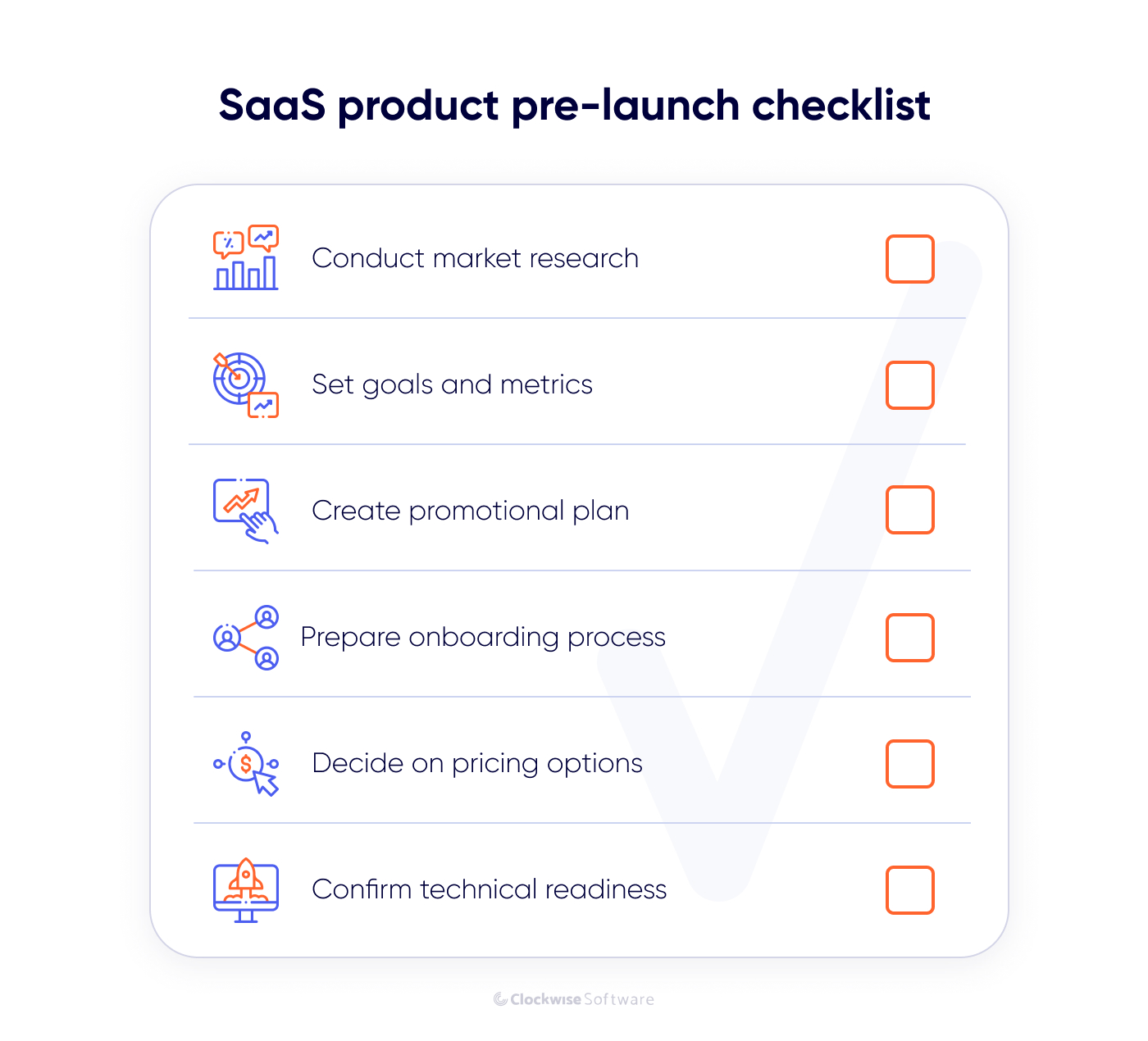
Credit: clockwise.software
Market Research
Understanding your audience is key to launching a successful SaaS product. Conduct surveys to gather insights on user needs and preferences. Analyze competitors to identify market gaps and opportunities.
Launching a SaaS product is an exciting journey, but it requires thorough preparation to ensure success. One of the most crucial steps in this process is conducting effective market research. Understanding your market helps you tailor your product to meet customer needs, stand out against competitors, and capitalize on emerging trends. Let's explore how you can achieve this by diving into identifying your target audience, analyzing competitors, and assessing market trends.
Identifying Target Audience
Knowing who your ideal customers are is paramount. Ask yourself: Who will benefit the most from your product? Consider demographics like age, gender, location, and income level. If you're targeting young professionals, your features and marketing should appeal to their fast-paced lifestyle and tech-savvy nature. Use surveys and social media polls to gather insights directly from potential users. Their feedback can provide surprising revelations about what they truly value.
Analyzing Competitors
Understanding your competitors is essential in carving out your niche. What are they doing right, and where are they falling short? Create a simple table listing competitors, their strengths, weaknesses, and market share. This visual can help you spot opportunities for differentiation. Consider subscribing to competitor newsletters or using their free trials to get firsthand experience. It’s a great way to identify gaps you can fill with your product.
Assessing Market Trends
Stay ahead by keeping an eye on market trends. Are there emerging technologies or changing consumer behaviors that could impact your product’s success? Follow industry blogs and forums. They often highlight shifts in customer preferences and new innovations, offering a wealth of information. Ask yourself: Is there a growing demand for your type of SaaS solution? If so, how can you refine your product to exceed expectations? Market research isn't just about gathering data—it's about turning insights into action. So, how will you use this knowledge to make your SaaS product irresistible?
Product Development
Launching a SaaS product involves careful planning and execution. Identify your target audience and develop a user-friendly interface. Prioritize customer feedback to refine features and ensure a successful market entry.
Product development is the backbone of launching a successful SaaS product. It’s where you turn a vision into a tangible offering. This stage sets the foundation for everything that follows, from marketing to scaling your business. Understanding the steps involved in product development can save you time and resources, and ensure your product meets user needs effectively. Let's delve into the key areas of product development that you need to focus on.
Defining Core Features
Start by identifying the essential features your SaaS product must have. Think about what problem your product is solving and what features are critical to addressing this problem. Avoid the temptation to include too many features at this stage. Focus on the features that will provide the most value to your users. You can add more later, once you have a solid understanding of what your users really want. Ask yourself: what would make your product indispensable?
Building A Minimum Viable Product
Once you’ve defined the core features, it's time to build a Minimum Viable Product (MVP). An MVP helps you test your product concept without investing too much time and money. It’s the bare-bones version of your product that solves the core problem for your users. The goal is to launch quickly and start getting real-world feedback. Consider how much you can simplify the product while still providing value. Remember, an MVP is about learning and iteration, not perfection.
Iterative Testing And Feedback
Testing and feedback are crucial to refining your SaaS product. After launching your MVP, gather feedback from users. Use this feedback to make informed decisions about improvements and new features. Involve users in the development process by asking them what they like, what frustrates them, and what they wish your product could do. Regularly update your product based on this feedback. This approach not only improves your product but also builds a relationship with your users. How do you incorporate feedback into your development process? Each iteration should bring you closer to a product that truly resonates with your audience.
Pricing Strategy
Launching a SaaS product requires a solid pricing strategy. A well-planned pricing approach can attract customers and drive revenue. Understanding how to set the right price is crucial for success.
Evaluating Pricing Models
Choosing a pricing model impacts customer interest. Subscription-based models are common in SaaS. They offer predictable revenue streams. Pay-per-use models suit services with variable usage. Consider a freemium model to attract users. It provides basic services for free and charges for premium features.
Understanding Customer Perceived Value
Customers pay based on perceived value. They assess the benefits of your product. Highlight your unique features. Ensure they understand how your product solves their problems. Conduct surveys to know customer expectations. Analyze competitor pricing to gauge market standards.
Creating Tiered Pricing Options
Tiered pricing offers flexibility. It caters to different customer needs. Basic tiers appeal to budget-conscious users. Advanced tiers attract users seeking more features. Consider offering enterprise-level tiers. Provide volume discounts for businesses with many users. Clearly define features in each tier to avoid confusion.
Credit: userlist.com
Go-to-market Plan
Launching a SaaS product requires a well-structured go-to-market plan. Identify your target audience and craft clear messaging. Develop a strong marketing strategy and ensure seamless user onboarding to drive engagement.
Launching a SaaS product is a thrilling journey that requires meticulous planning. One of the most critical components of this journey is your Go-To-Market Plan. This plan is your roadmap to successfully introducing your product to the world. It involves several strategic steps that ensure your product not only reaches your target audience but resonates with them. Let’s dive into the essential elements of a Go-To-Market Plan.
Crafting A Unique Value Proposition
Your product needs to stand out in a crowded market. This is where a unique value proposition (UVP) comes into play. A UVP clearly articulates why your product is different and why it matters. It’s the answer to the question, "Why should customers choose you over the competition?" Think about what pain points your product solves. Does it save time, reduce costs, or enhance productivity? Make your UVP concise and compelling. Remember, it's your first impression—make it count.
Developing Brand Messaging
Once you've nailed down your UVP, it's time to develop your brand messaging. This involves crafting the words and phrases that define how you communicate with your audience. Your messaging should reflect your brand’s personality and resonate with your target market. Consider your tone—should it be professional, friendly, or innovative? Align your messaging with your audience's preferences and expectations. Consistency is key; use your messaging across all marketing channels to build trust and recognition.
Identifying Key Marketing Channels
Now that you have your UVP and messaging, it's crucial to identify the right marketing channels. Not all channels will be effective for your product. You need to go where your audience is. Research where your potential customers spend their time online. Is it on social media, forums, or industry-specific websites? Focus your efforts on channels that give you the most visibility and engagement. Consider a mix of organic and paid strategies to maximize your reach. Launching a SaaS product is an exciting endeavor with many moving parts. The right Go-To-Market Plan can be the difference between success and obscurity. Are you ready to introduce your product to the world with confidence?
Sales Strategy
Launching a SaaS product is an exciting journey, but success hinges on a solid sales strategy. A clear strategy helps reach customers and maximize revenue. Here, we focus on three key areas: building a sales funnel, leveraging partnerships, and scaling sales operations.
Building A Sales Funnel
Crafting a sales funnel is crucial. First, understand your target audience. Create buyer personas to pinpoint their needs. Next, map the journey from awareness to purchase. Use engaging content to guide prospects at each stage. Implement tracking tools to monitor progress. Optimize the funnel based on feedback and data. A refined funnel converts leads into loyal customers.
Leveraging Partnerships
Partnerships can boost your sales efforts. Identify companies with complementary services. Collaborate to offer bundled solutions. Co-host webinars or events to reach wider audiences. Share resources and insights for mutual benefit. Partnerships expand reach and enhance credibility. Choose partners wisely to align with your brand values.
Scaling Sales Operations
Scaling sales operations requires planning. First, automate repetitive tasks with CRM tools. Train your sales team regularly to improve skills. Set clear goals and track performance metrics. Adapt strategies based on changing market trends. Expand your team when demand increases. Efficient scaling ensures sustained growth and profitability.
Customer Acquisition
Launching a SaaS product involves more than just development. Customer acquisition is key. You need users to sustain and grow. Attracting the right audience ensures success. It involves strategic planning and execution. Several methods can help you reach potential customers effectively.
Utilizing Digital Marketing
Digital marketing is a powerful tool. Start with social media platforms. They provide direct access to your audience. Create engaging posts. Use eye-catching graphics. Consider paid ads for wider reach. Google Ads can also target specific keywords. Optimize your website for search engines. Ensure it loads quickly and is mobile-friendly.
Engaging In Content Marketing
Content marketing builds trust with your audience. Write blogs about your product's benefits. Share case studies and testimonials. Create informative videos or webinars. Answer common questions your audience might have. Use newsletters to keep users informed. Regular content updates keep users engaged.
Implementing Referral Programs
Referral programs can boost customer acquisition. Encourage users to share your product. Offer incentives for successful referrals. Discounts, credits, or free features work well. Make the process simple and user-friendly. Track referrals for effectiveness. Adjust your program based on feedback.
Customer Retention
Launching a SaaS product requires strategies for customer retention. Start by offering personalized onboarding experiences. Regularly engage users with helpful content, updates, and support.
Launching a SaaS product is just the beginning; keeping your customers engaged and satisfied is where the real work begins. Customer retention is crucial for long-term success. It’s not just about getting users to sign up, but ensuring they stay and find value in what you offer. Every interaction with your product should make your users feel valued and understood. Let's dive into the essential strategies for retaining your customers.
Enhancing Customer Experience
A seamless customer experience can be your biggest asset. Consider the last time you used an app that frustrated you. Chances are, you didn’t stick around long. Make sure your SaaS product is intuitive and user-friendly. Regularly update your interface based on user behavior analytics. Personalization can also enhance experience. Tailor features to individual user needs. This can make users feel like your product was designed just for them.
Providing Exceptional Support
No product is perfect, and users will have questions. How you handle these can make or break customer loyalty. Offer multiple channels for support such as chat, email, and phone. Quick and effective responses show you care about your users’ needs. Consider creating a comprehensive FAQ section or a community forum. This not only helps users find answers quickly but also builds a community around your product.
Monitoring Customer Feedback
Feedback is a goldmine for improving your SaaS product. Are you actively listening to what your users are saying? Implement a feedback system that makes it easy for users to share their thoughts. This could be through surveys or an in-app feedback feature. Analyze this feedback to identify common issues or desired features. Then, take action. Show your users that their opinions matter and you’re committed to improving their experience. Retention is not just a number; it’s a relationship. How will you nurture it?
Performance Metrics
Launching a SaaS product is an exciting journey. To ensure success, monitoring performance metrics is essential. These metrics help understand the product's health and user satisfaction. By focusing on key metrics, you can make data-driven decisions. Let's dive into some critical performance metrics for SaaS products.
Tracking Key Performance Indicators
Key Performance Indicators (KPIs) are vital for assessing progress. Revenue growth, user acquisition, and engagement rates are important KPIs. Use tools like Google Analytics to track these KPIs. Regularly review your KPIs to spot trends and areas for improvement. This helps in aligning strategies with business goals.
Analyzing Customer Lifetime Value
Customer Lifetime Value (CLV) shows the total revenue from a customer. To calculate CLV, consider the average purchase value and purchase frequency. A higher CLV indicates a strong customer relationship. Improving CLV can lead to increased profitability. Focus on enhancing customer experiences to boost CLV.
Assessing Churn Rate
Churn rate measures the percentage of customers leaving over time. A high churn rate can signal issues with your product. To calculate churn rate, divide lost customers by total customers at the start. Understanding churn helps identify areas needing attention. Reducing churn can lead to sustained growth and stability.
Scaling Strategies
Launching a SaaS product requires smart scaling strategies. Focus on customer needs to build a strong foundation. Implement agile development and efficient marketing to reach wider audiences effectively.
Scaling your SaaS product is both a challenging and exciting journey. It requires strategic planning and a clear understanding of the growth paths available. By focusing on expanding features, entering new markets, and optimizing operations, you can propel your SaaS product to new heights. Let's dive into each of these strategies.
Expanding Product Features
Enhancing your product features is a powerful way to meet evolving customer needs. Regularly gather feedback to identify what users are missing or struggling with. Imagine the satisfaction when a new feature perfectly addresses their needs. For example, when we added a collaboration tool to our SaaS, customer engagement soared. This wasn't just about adding functionality; it was about deepening our understanding of user workflows. How can your product evolve to better serve your customers?
Entering New Markets
Exploring new markets can significantly boost your user base. Start by researching regions with unmet needs that your product can fulfill. Is there a market segment you've overlooked? We once discovered a niche market by simply analyzing our existing user data. This insight led us to tailor our marketing and product features, resulting in a substantial growth spike. Consider what untapped market could be waiting for your solution.
Optimizing Operational Efficiency
Streamlining operations is crucial for scalability. Evaluate your processes to eliminate bottlenecks and reduce costs. Could automation or outsourcing improve your workflow? We faced challenges with customer support response times. By implementing a chatbot, we not only sped up responses but also freed up our team for more complex queries. Think about areas where efficiency can be improved without compromising quality. Scaling a SaaS product involves strategic choices that align with your vision and capabilities. What steps will you take to ensure your product grows sustainably and effectively?
Case Studies
Case studies offer valuable insights into launching a SaaS product. They reveal successful strategies and pitfalls to avoid. Analyzing real-world examples can guide you through the complex process.
Successful Launch Examples
Dropbox began as a simple idea. Its beta launch created a buzz. Word-of-mouth marketing played a key role. Users shared their experiences, increasing visibility. Offering extra storage for referrals boosted growth. Today, Dropbox is a household name.
Slack’s launch strategy focused on user feedback. Early adopters were crucial. Regular updates improved the product. Their integration with other tools attracted more users. Slack’s success lies in its community-driven approach.
Lessons Learned From Failures
Quibi’s failure teaches the importance of market understanding. It launched with high expectations but missed the mark. Short-form content was not enough. Lack of audience research led to its downfall. Listening to user needs is vital.
Google Wave struggled to find its audience. It was too complex for users. Poor communication about its benefits affected its success. Simplicity and clear messaging are key lessons from its failure.
Innovative Approaches In The Industry
Notion’s collaborative features made waves. It combined note-taking, task management, and databases. This multifaceted approach attracted diverse users. Its flexibility set it apart. Notion’s innovation lies in its adaptability.
Asana introduced a unique way to manage tasks. Its user-friendly interface appealed to teams. Integration with other platforms added value. Asana’s success is rooted in usability and integration.
These case studies highlight strategies for launching a successful SaaS product. They offer lessons in user engagement, market understanding, and innovation.
Credit: userpilot.com
Frequently Asked Questions
How To Launch A Saas Product Successfully?
To successfully launch a SaaS product, conduct market research, and build a strong development team. Create a compelling value proposition and implement a strategic marketing plan. Engage with early adopters for feedback and iterate based on insights. Ensure a seamless onboarding process and prioritize customer support.
What Is The 3 3 2 2 2 Rule Of Saas?
The 3 3 2 2 2 rule in SaaS refers to a framework. It guides customer success teams to focus on onboarding, engagement, and retention. The numbers represent a timeline for customer interactions: 3 months for onboarding, 3 months for engagement, and 2 months each for renewal, expansion, and advocacy.
How To Introduce Saas?
Introduce SaaS by explaining its benefits, such as cost-effectiveness and scalability. Highlight its cloud-based nature and flexibility. Demonstrate its ability to streamline operations and enhance productivity. Emphasize user-friendly interfaces and regular updates. Address security features to build trust.
How To Pitch A Saas Product?
Understand your target audience's needs. Highlight unique features and benefits. Demonstrate real-world use cases. Offer a free trial or demo. Address potential objections confidently.
Conclusion
Launching a SaaS product is an exciting journey. It requires careful planning and execution. Understanding your market is crucial. Know your audience and their needs. Develop a reliable product that solves real problems. Build a strong team that shares your vision.
Focus on marketing to reach potential users. Offer great support to keep them happy. Monitor feedback and adapt quickly. Stay committed and patient. Success doesn't happen overnight. Keep improving and innovating. Your dedication will pay off. Ready to launch your SaaS product?
Start now and make your mark in the tech world!